Cash rounding
Round what a customer pays in lira to notes that exist, choose the step and the direction, and see what the rounding does to the sale and its VAT.
Checked against the product on 13 October 2026
Lebanon no longer uses small lira notes, so a lira total such as LBP 7,159,105 cannot be paid as it stands. Cash rounding sets what the till asks for instead: the amount due in lira, rounded to a step you choose. The rounding is part of the sale: the sale is booked at the rounded amount, and VAT is declared on it. The setting is the Cash rounding card on SettingsFinancePayment methods.
The setting
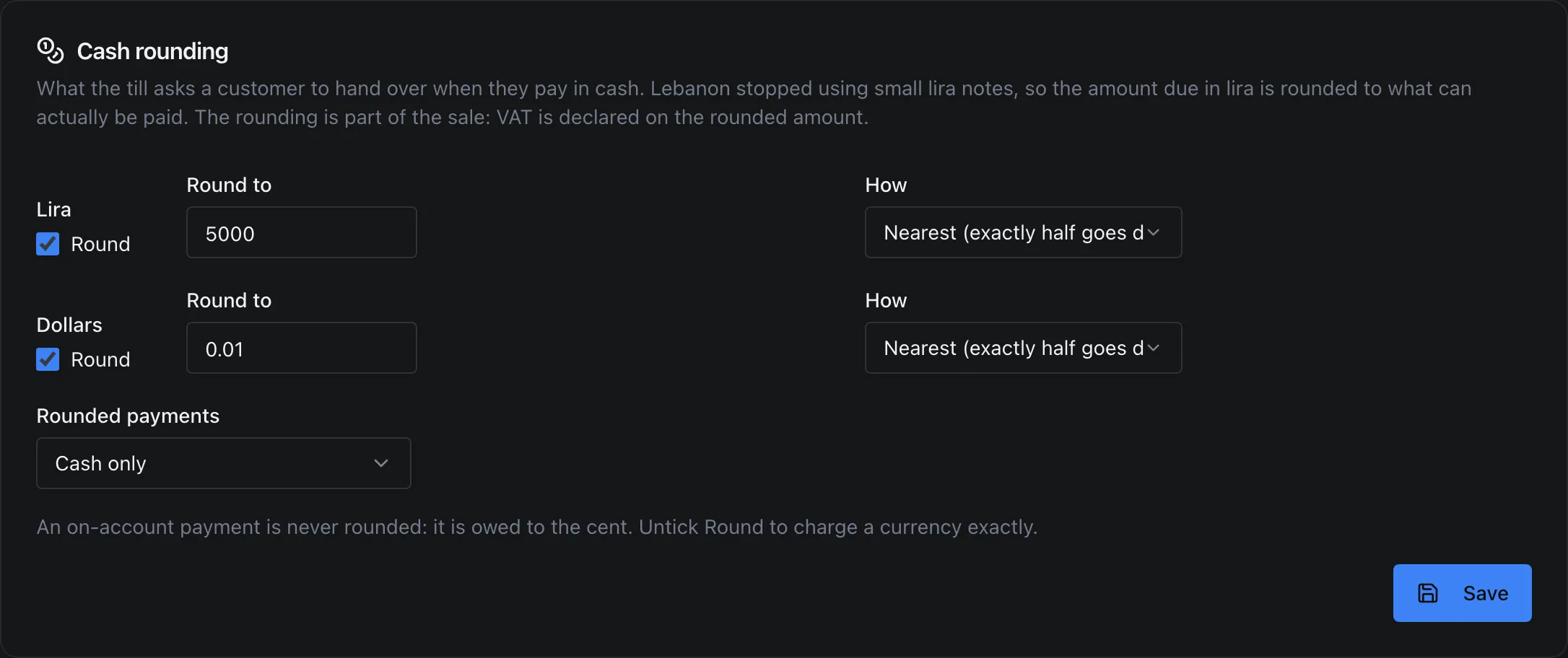
One row for Lira and one for Dollars, each with:
| Field | What it does |
|---|---|
| Round | Ticked, the currency is rounded. Unticked, it is charged exactly, to the lira or the cent. |
| Round to | The step: an amount the result is a multiple of. Lira: a whole number from 1 to 1,000,000 (5000 is the nearest 5,000). Dollars: from 0.01 to 10, two decimals at most. |
| How | Nearest (exactly half goes down), Always down, or Always up. |
and, for both, Rounded payments: Cash only or Cash and card. A payment on account is never rounded: it is owed to the cent. Press Save; the message Cash rounding saved confirms it. A step outside the limits is refused with a message that names the currency and the limit, for example Dollars: the step can be at most 10. or Lira: the step must be a whole amount, with no decimals.
A new business starts with lira rounded to the nearest 5,000, dollars to the nearest cent (which rounds nothing), and cash only.
Nearest, exactly half
With Nearest, more than half a step rounds up and less rounds down. Exactly half goes down on what the customer pays, and up on change handed back: a tie always goes the customer's way. At a step of 5,000, for change in lira on a payment in dollars:
| Exact amount | To pay | As change |
|---|---|---|
| LBP 7,159,105 | LBP 7,160,000 | LBP 7,160,000 |
| LBP 897,300 | LBP 895,000 | LBP 895,000 |
| LBP 897,500 (exactly half) | LBP 895,000 | LBP 900,000 |
At the till
The cart, the bill and the payment screen show the lira total already rounded (see Taking payment). When the customer pays cash in lira (Paid in, Lira), the payment screen shows Due in lira and, when rounding changed it, Rounded from the exact amount.
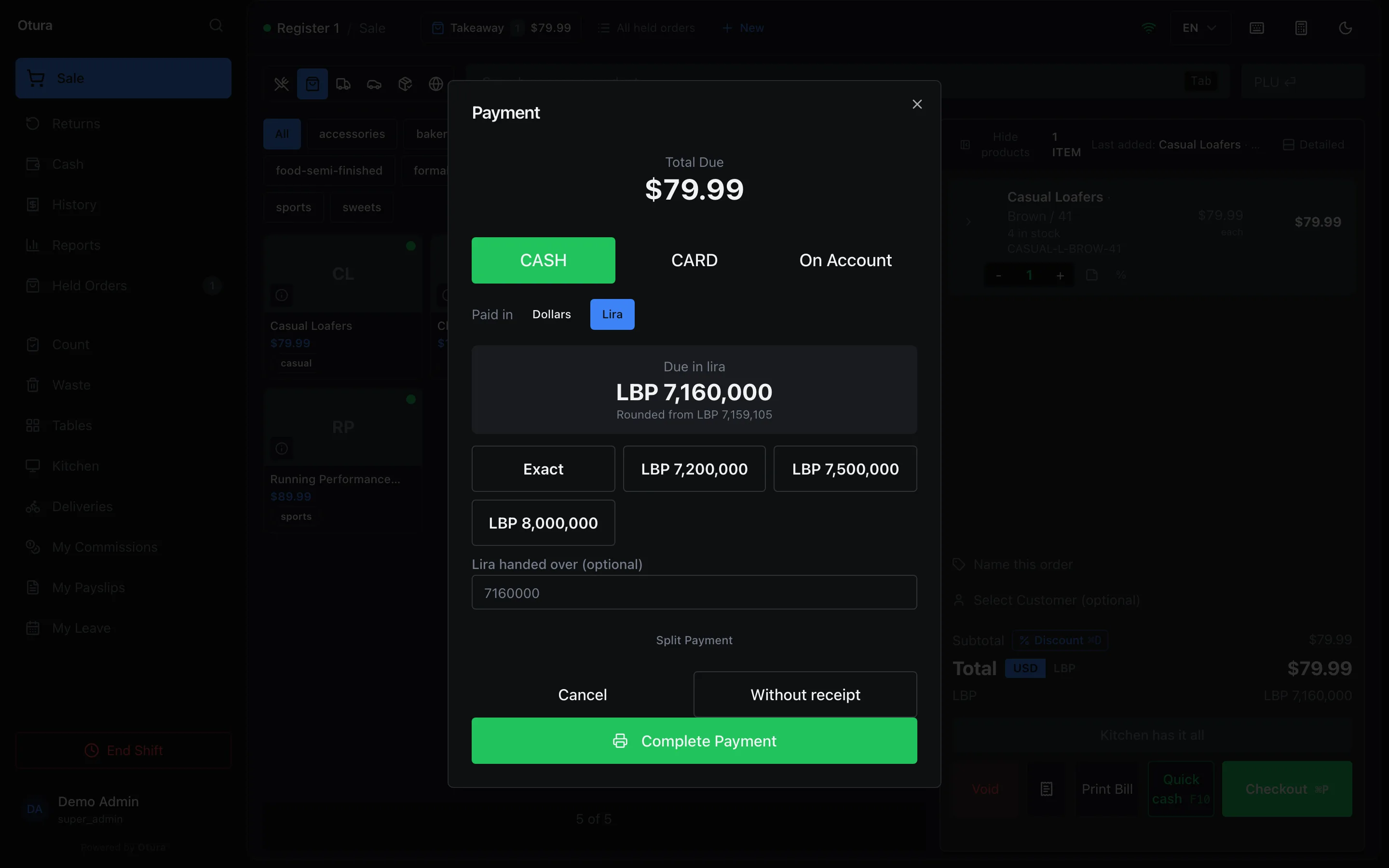
What is rounded:
- cash paid in lira, by the Lira row;
- cash paid in dollars, by the Dollars row, when its step is more than a cent;
- a card payment, only with Cash and card;
- change given in the other currency (dollars handed over, change in lira, or the reverse), worked out at the sale's rate and then rounded by that currency's row. Change in the currency that was handed over is simply the difference: LBP 1,000,000 handed over for LBP 895,000 due gives LBP 105,000;
- in a split payment, only the last part: the parts before it are taken as typed, and the last one is rounded in its own currency.
If the owner changes the rule while a sale's payment screen is open, the payment is refused and the amount due worked out again: The shop's cash rounding changed while this sale was open. The amount due has been updated: check it and complete the payment again.
What the rounding does to the sale
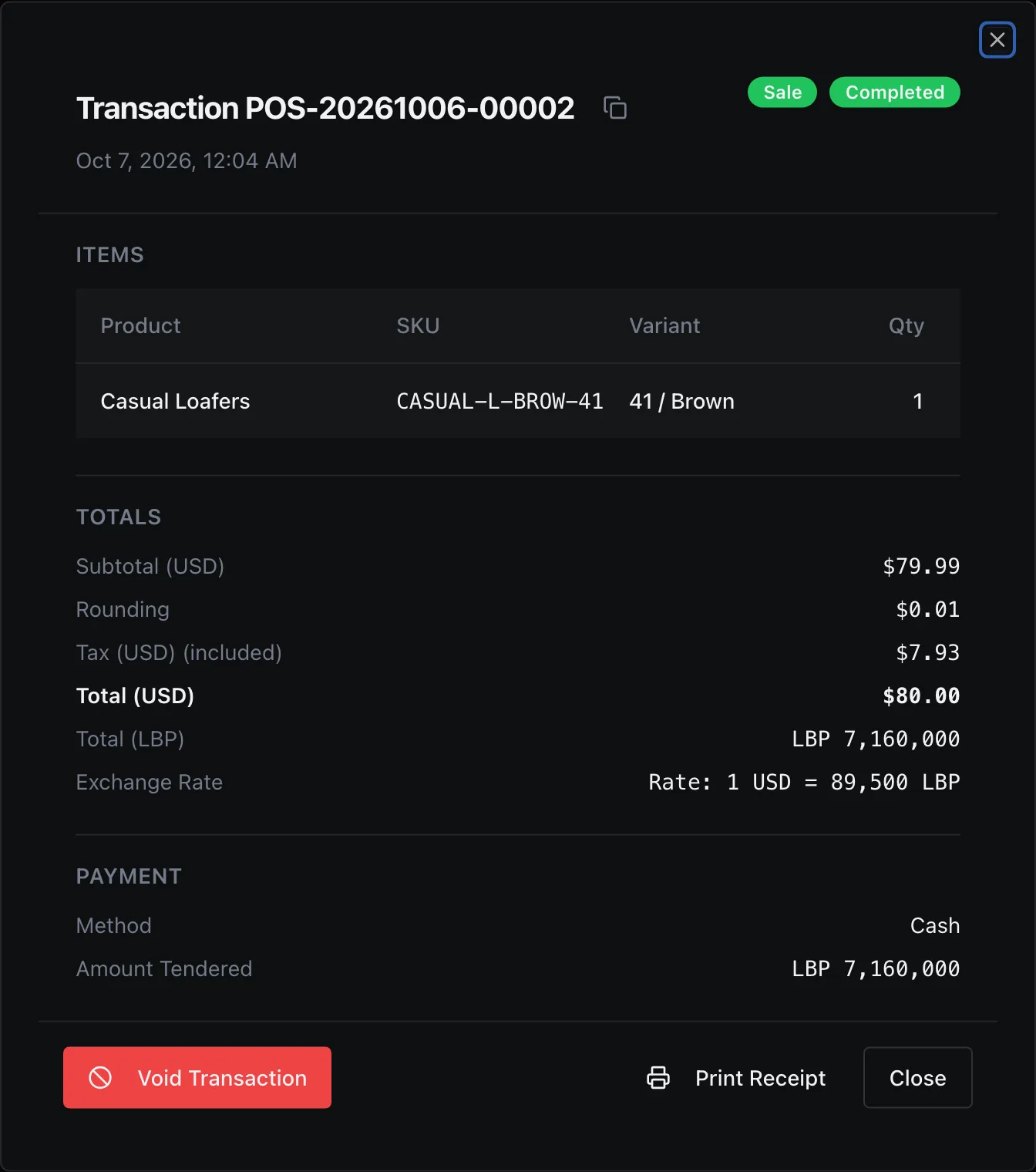
The sale is booked at what was actually paid. In the example, LBP 7,160,000 at 89,500 is $80.00, so the sale is an $80.00 sale, not a $79.99 one: the extra cent is a Rounding line on the receipt and on the sale's detail in StoreTransactions, and the VAT included in the sale is worked out on the $80.00. There is no separate rounding account: the rounding is part of the sale's revenue and its VAT. A rounding down is a negative Rounding line, and the sale is booked for less.
A return gives back the returned items plus their share of the sale's rounding, so the refunds of a sale never add up to more than was collected. The refund goes back the way the sale was paid: a sale paid in lira cash is refunded in lira, and the return lists what to hand back under Hand back (see Returns and exchanges).
The rounding is already inside the sales figures, never added on top. When there was any, the shift's closing summary, the X report and the Z report show it as Rounding (included), and the shift's closing report has a Rounding row. Sales invoices and customer receipts are never rounded.